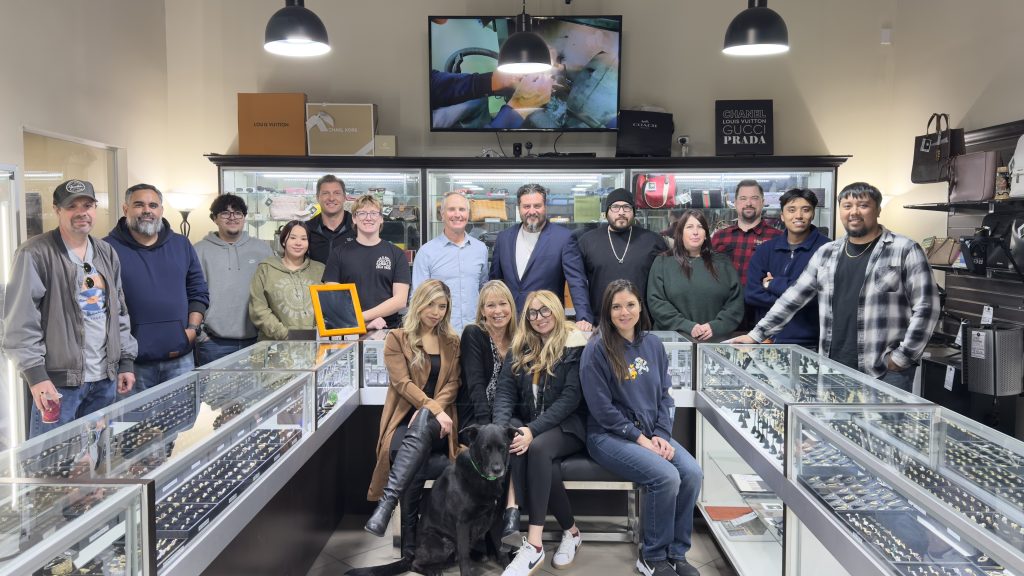
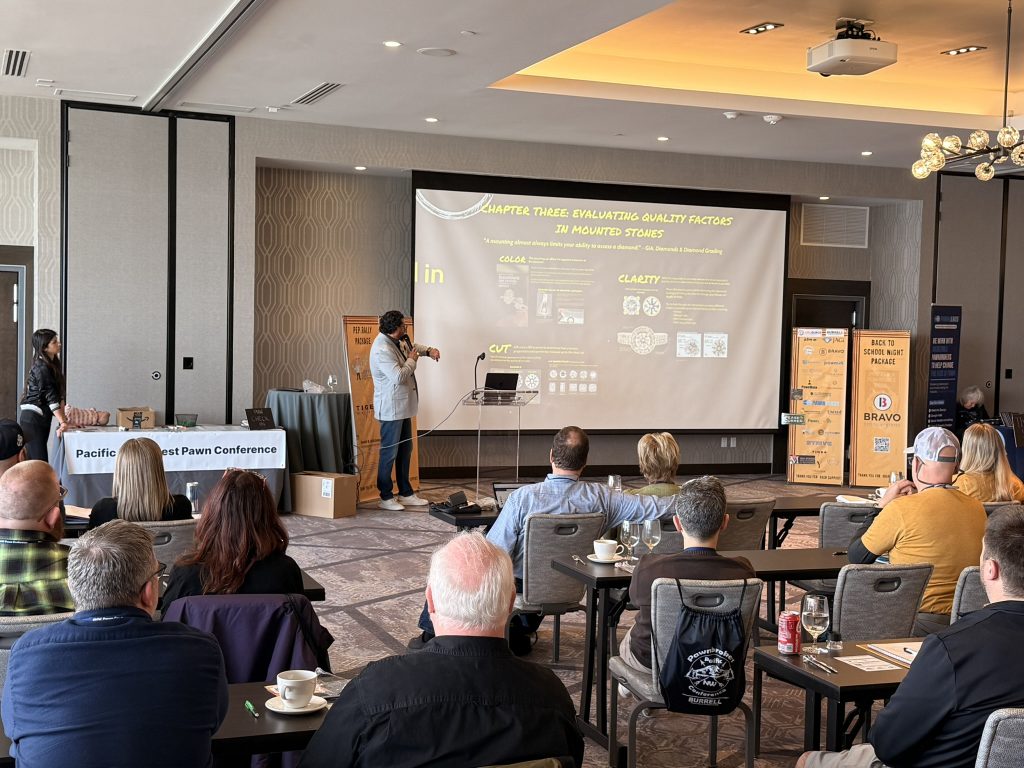
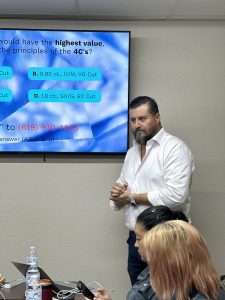
“Diamonds for Pawnbrokers” teaches pawnbrokers how to look at and think about diamonds in the context of their everyday work, utilizing the tools they have available to them behind the loan counter.
The presentation discusses topics that, as a pawn shop owner, Moris Adato (GIA Graduate Gemologist, president of CashCo Pawn and JAGi Lab) has identified as particularly important and useful for pawnbrokers to understand, including:
Set Up For Success: What You Need Behind The Counter to Look At Diamonds
Measuring and Estimating Diamond Carat Weight
Evaluating Diamonds Mounted In Jewelry
The Difference between Natural Diamond, Lab Diamond, CZ and Moissanite
Natural vs. Lab-Grown Diamonds: Understanding the Selling Points
The GIA 4C’s – For Diamonds Mounted in Jewelry
Valuing and Pricing Both Natural and Lab Diamonds
Understanding The Selling Points of Natural and Lab Diamonds
How To Use Certifications to Write Better Loans and Increase Sales Profits
The information in this presentation will hone the skills of your team in looking at, identifying, evaluating, and writing loans on diamonds, lab grown diamonds, and lookalike stones- using the tools available to them behind the counter.
Each attendee will get a gift bag with tools to practice methods described in the course with example stones (tweezers, loupe, diamond sizer), plus a certificate of completion and a PDF of the presentation slides they can keep and refer to anytime.
For $2,500.00 plus travel expenses, Moris will travel to your shop and present to up to 25 members of your team (You might combine forces with another nearby shop, sending team members from both stores and splitting the cost).
We’re sure your team will enjoy the presentation, and you’ll enjoy the results as they apply what they’ve learned in their daily tasks.
If you’re interested to schedule a presentation with your team at your store, give the lab a call at 619-269-6729, or shoot us an e-mail at contact@jagilab.com. Be sure to include your name, store name, and a good contact number.
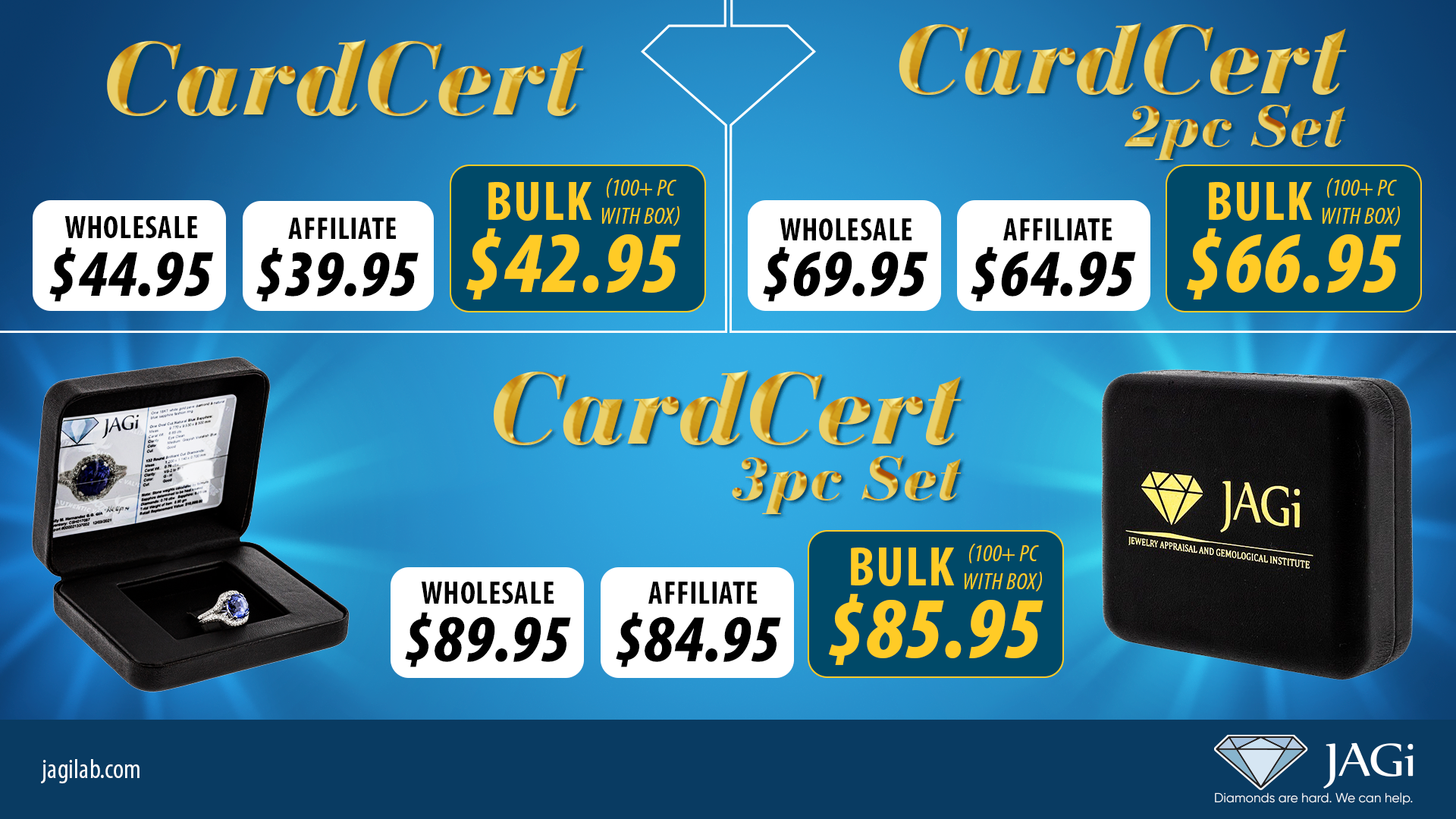
Our lab has updated our service menu and pricing to enable us to continue to provide knowledgeable, professional, and accurate jewelry appraisal and gem identification services. We strive to continue to improve services and provide thorough, well-researched information to you, our clients.
We’re excited to share new bulk pricing for wholesale customers sending 100 pieces or more at a time! We thank you for your continued business.
APPRAISAL SERVICES
Wholesale
Affiliate
Bulk (Bulk price includes jewelry box)
CardCert Jewelry Appraisal
$44.95
$39.95
$42.95
CardCert Jewelry Appraisal (2PC Set)
$69.95
$64.95
$66.95
CardCert Jewelry Appraisal (3PC Set)
$89.95
$84.95
$85.95
Full Jewelry Appraisal
Starting at $69.95
All other pricing – same as wholesale
All other pricing – same as wholesale
Full Jewelry Appraisal (2PC)
Starting at $99.95
Full Jewelry Appraisal (3PC)
Starting at $129.95
Full Appraisal Add-On
$39.95
Designer Authentication
$25.00+ (depending on complexity)
Designer Authentication (Full Appraisal)
$89.95
Watch ID Card
Starting at $125.00
Watch Full Appraisal
Starting at $175.00
Gem ID
$20.00
Web Photos (3 photos + 30 second video)
$45.00
Jewelry Box
$4.95
Update CardCert (services/pricing)
$10.00
Reprint CardCert
$5.00 (+$2.00 shipping)
GIA Concierge Service
$50.00 (in addition to GIA fees)
MELEE/LOOSE STONE SERVICES
Melee Sorting
$3.00/ct
Frosting
$1.00/ct (minimum $50.00, max $100.00) *REQUIRED
“Supersort” (separate more finely than standard process)
$60.00/hr
“The Real Deal”
Free to ID stones of value, then offer CardCert appraisal for stones worth $300.00+ (wholesale value)
Gemstone Sorting
$60.00/hr
Stone Recut/Repolish Services
TBD
Matching Diamonds (pairs, set, etc.)
$60.00/hr
REPAIR SERVICES
Provide & Replace Melee
$10.00 set fee + cost of stone
Diamond Unmounting (Prong Set)
$10.00/ct
Diamond Unmounting (Other Settings)
TBD
Gemstone Unmounting
TBD
Diamond Mounting (Prong Set)
$25.00/ct
Diamond Mounting (Other Settings)
TBD
Gemstone Mounting
TBD
Clean
$3.00
Refurbishing (Single ring, polish & clean)
$15.00
Refurbishing (2pc set, polish & clean)
$30.00
Refurbishing (3pc set, polish & clean
$45.00
Refurbishing Large (bracelets, large pendants/earrings, etc.)
$25.00
Refurbishing (Restore to like new condition, single ring)
$30.00
Rhodium Plating (Single Ring)
$50.00
Rhodium Plating (2pc)
$75.00
Rhodium Plating (3pc)
$110.00
Rhodium Plating Large
TBD
Prong Repair
TBD
Soldering
TBD
Add Earring Backs
TBD
Watch Polishing (Gold, Stainless Steel, 2TN, etc)
$100.00 (more complex pieces may incur an additional fee)
Split Soldered Set (2) – YG
$35.00
Split Soldered Set (2) – WG
$110.00 (requires rhodium plating on both rings)
Split Soldered Set (3) – YG
$60.00
Split Soldered Set (3) – WG
$170.00 (requires rhodium plating on all three rings)
The first Rapaport Price List (or “Rap Sheet”) was published in 1978 by Martin Rapaport, then a wholesale diamond broker in New York City. Today, the Rap Sheet is the industry standard used to establish diamond prices all over the world, and Martin Rapaport serves as CEO of the Rapaport Group.
The Rapaport Group has a huge presence in the diamond industry worldwide. They employ “over 220 team members in offices in New York, Las Vegas, Ramat Gan, Jerusalem, Antwerp, Mumbai, Surat and Hong Kong, serving more than 20,000 clients in 120 countries.” In addition to the Rapaport Price List, they manage RapNet (the world’s largest diamond and jewelry trading platform), RapLab (a diamond grading laboratory), and Rapaport Fair Trade, which works towards creating “a freer and fairer diamond industry”.
Understanding the Rap Sheet is essential for anyone buying and selling diamonds- whether you’re pricing items for sale in your retail store, figuring out a fair wholesale price for a colleague, or making sense of an offer from a dealer.
HOW DO I ACCESS THE RAP SHEET?
You’ll need a paid subscription to Rapaport, which has several different levels of membership available depending on your needs. The minimum required to access the Rap sheet is a subscription to Rapaport Magazine ($210.00/year). This includes access to the RapNet price calculator and TradeScreen, which are both handy for pricing research. If you want access to resources such as diamond price analysis tools, access to chat/trade groups, and the ability to list diamonds and jewelry for sale, additional levels of membership are available.
HOW DO I READ THE RAP SHEET?
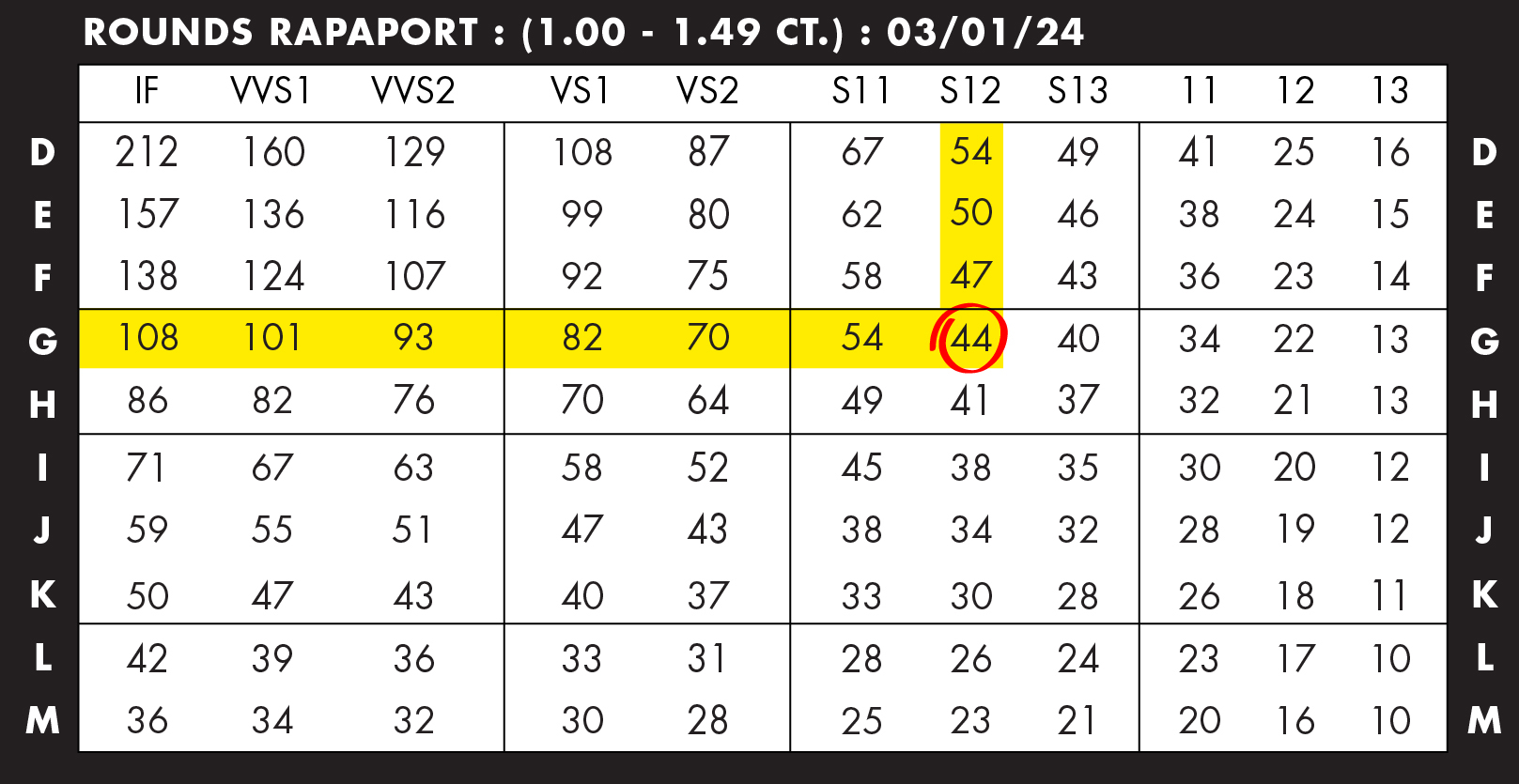
The Rap Sheet is organized into tables. At the top of the table, there is a weight range, date, and shape–either “ROUND” or “PEAR”. Round is for round brilliant shapes. Pear refers to all the others (pear, baguette, princess, etc). Each table contains prices for a range of sizes that use the same number as the per carat price. The size groups Rapaport uses are below.
Let’s say we have a 1.03 ct. RBC diamond. It’s an SI2-G. Find the chart with the appropriate size range (1.00 – 1.50 ct.) and cut (ROUND) at the top.
In the black border around the chart, you’ll see letters in a column down both sides. These represent diamond color grades, D-M. At the top of the chart, you’ll find a row of diamond clarity grades, IF- I3.
The numbers you see in the table are per-carat prices, expressed as 1/100 of the number they represent. This saves space and makes the table easier to read.
Find the color (G) in the column at the left-hand side of the table. Find the clarity grade (SI2) in the top row.. The number you find where the column and row meet is the number we’ll input into the formula below to get the Rappaport price for our stone.
NUMBER FROM RAP SHEET x 100 x CARAT WEIGHT = HIGH CASH ASKING PRICE
For example: $44 x 100 x 1.03 = $4,532.00
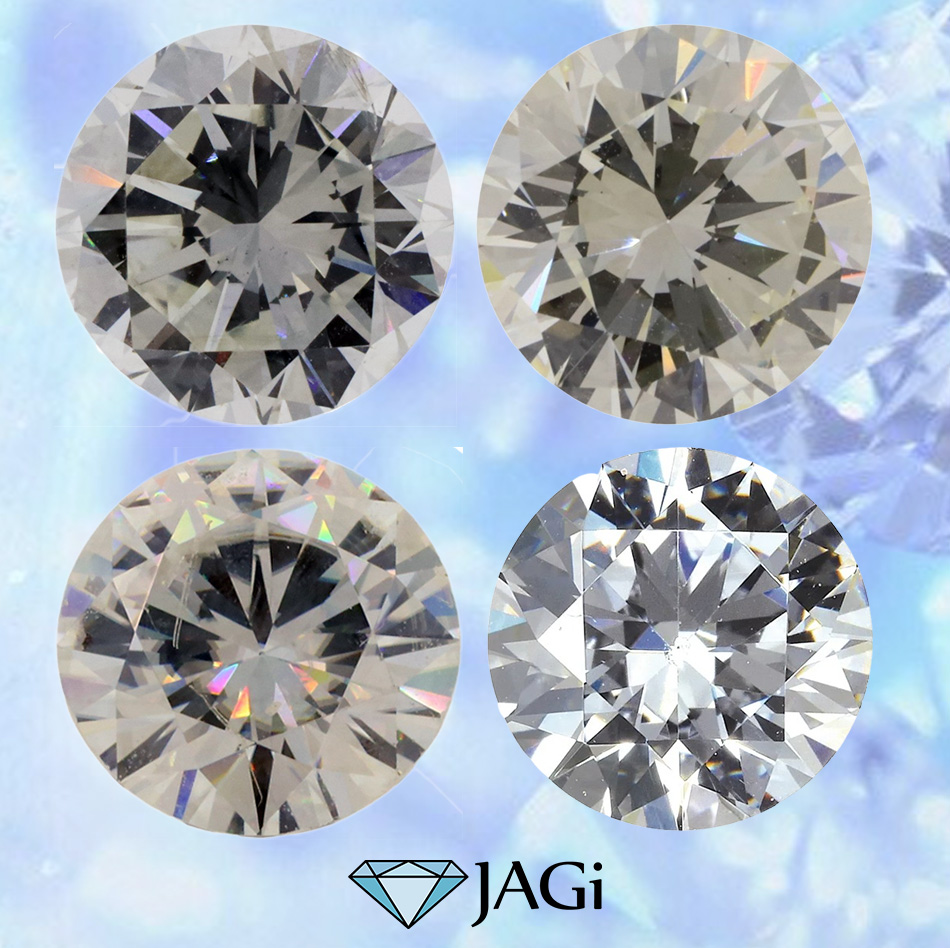
In the below image, you can see how increasing or decreasing the carat weight affects the value of of our stone, all other factors being equal:
HOW DO I USE THE RAP SHEET?
Remember: the Rap Sheet is not a price list. It is intended to be used as a benchmark, or point of reference.
It’s important to note that the prices in the Rapaport list are based on Rapaport Diamond Specification “A3”. For a breakdown of Rapaport specifications, click here. If your stone has specifications that fall outside of the requirements for an “A3” stone, you should start discounting from the price indicated on the Rap sheet.
Most retailers and wholesalers price their items “back” of Rap, or at a discount from the amount on the Rap Sheet. For example, if a dealer offers to sell you a stone for “40 back of Rap,” they are referring to a price that is 40% less of the current Rapaport value for a stone of the same size and quality.
Rapaport does not include lab-grown stones in the price list, but you might approximate the wholesale value of a lab grown diamond by calculating 95-98% of the Rapaport value for a natural diamond with the same specifications.
Natural, lab grown, moissanite- they all have a place in your showcase!
As a pawn shop owner, it is important to realize: there is no such thing as “fake diamonds”.
At the lab, we often hear the term “fake diamonds” used in reference to both lab-grown diamond and moissanite. Delete this term from your vocabulary! It’s misleading and confusing.
Natural diamonds, lab-grown diamonds, and moissanite are each beautiful stones with their own unique appeal. Understanding how these gems are different will help you see the value in each and explain the difference to your customers.
DIAMONDS
DIAMOND SIMULANTS
Diamonds are the hardest mineral on Earth. They form naturally within the Earth over millions of years. They can also be grown in a laboratory.
Diamond simulants are stones that are similar in appearance to diamond. These stones are completely different minerals.
NATURAL DIAMOND
LAB-GROWN DIAMOND
Moissanite
CZ
WHAT IS IT?
Natural diamonds are beautiful, rare, and durable. Form through natural geological processes deep beneath the Earth’s crust over millions of years. Value is determined by color, cut, clarity and carat weight (“The Four C’s).
Lab-grown diamonds are diamonds. They are exactly the same as natural diamonds in every way- except how they form. Created through synthetic processes in a laboratory. Can be fully formed in a matter of weeks. Value is based on the four C’s- but since lab-grown diamonds are manmade and can be made in any quantity at any time, they are not rare. Therefore, they are less valuable than natural diamonds.
Moissanite is a gemstone frequently used as a diamond simulant. Moissanite is rare in nature. Stones used in jewelry are lab-created.
Cubic zirconia is a man-made stone frequently used to imitate diamond. Inexpensive and readily available. Stones used in jewelry are lab-created.
HOW CAN I IDENTIFY IT?
Virtually all naturally formed diamonds have inclusions. Singly refractive. Known for optical properties like fire, scintillation, and brilliance. Facets will be sharp and exact. Some diamonds (but not all) fluoresce under UV light.
Lab-grown diamonds are diamonds. Same optical properties as natural diamonds- cannot be separated visually, only with specialized equipment. The girdle of a lab-grown diamond may be inscribed (look for “LG”, “LGD”, etc.) but isn’t always. Some lab-grown diamonds (but not all) fluoresce under UV light.
Almost always eye-clean, but sometimes displays unique “stringer” inclusions Doubly refractive Displays extreme fire (the rainbow shimmer of colors created by light refraction). Typically does not fluoresce under UV light.
Eye-clean, usually inclusion free Displays extreme fire Singly refractive Not as hard as diamond, so look for rounded facet junctions under magnification. Typically does not fluoresce under UV light.
HOW DO I VALUE IT?
The industry standard for pricing diamonds is the Rapaport Price List, or “Rap Sheet”. Values diamonds based on their color, cut, clarity, and carat weight.
Companies like Rare Carat and Brilliant Earth have websites where you can shop lab-grown diamonds. Narrow your selection by color, cut, clarity, and carat weight to get an idea of what a similar stone would retail for.
Can be purchased online from wholesale retailers such as Stuller.
Can be purchased online from wholesale retailers such as Stuller.
HOW DO I SELL IT?
Emphasize the rarity, beauty, &romance of natural diamonds with luxurious showcase displays. Sell stones with third-party authentication. Add value to the sale by offering insuranceappraisals with purchase.
Lab-grown diamonds differ from diamonds in non-tangible ways that might appeal to certain kinds of consumers: they are more affordable, more eco-friendly,and are considered to be a more ethical choice than mined diamonds.
Moissanite is a unique gem with optical properties that consumers might prefer to those of diamond: it has stronger fire, displays more brilliance and is typically inclusion-free.
CZ stones have extreme fire, brilliance and are inclusion-free- they have more “sparkle” than diamonds and are more showy. CA is inexpensive compared to diamonds and can be easily replaced.